
Making a Difference
Rebuilding lives: prosthetics and rehabilitation for Afghan veterans
For thousands of Afghan men and women who survived the country's decades of conflict, the journey back to daily life often begins with a prosthetic limb, a wheelchair, or a course of physical therapy. The United Nations, working alongside Afghan ministries and non-governmental organizations, has been a steady provider of these services since the early 2000s. While headlines often focus on security and governance, the quieter work of restoring mobility and independence continues in rehabilitation centres from Kabul to Herat.
Disability in Afghanistan carries a social weight that extends far beyond the physical. Veterans with missing limbs or mobility impairments frequently face barriers to employment, marriage, and community participation. The UN's approach combines the supply of modern prosthetic components with training for local technicians, ensuring that the country can maintain and expand its rehabilitation capacity long after international attention moves elsewhere. This model offers lessons for other post-conflict societies, including elements that resonate with how Australia approaches veteran support through its own national schemes.
Understanding the need among Afghan veterans
The legacy of war in Afghanistan has left an estimated one million people living with some form of physical disability, a significant portion of whom are former combatants or civilians injured during military operations. Mine incidents, improvised explosive devices, and crossfire have generated a steady stream of amputees and spinal cord injuries over four decades. Veterans form a particularly visible group because their injuries are often sustained in service of the state or local militias, creating an expectation of recognition and care.
The UN Assistance Mission in Afghanistan, working through agencies such as UNICEF, WHO, and UNOPS, has tracked these patterns through community-based surveys. The data consistently shows that demand for orthotic and prosthetic devices far outstrips supply, particularly outside major urban centres. Rural provinces such as Baghlan, Balkh, and Kandahar rely on mobile clinics and referral systems that bring specialists to patients who cannot easily travel. This decentralised approach mirrors outreach models used in remote parts of Australia, where the Royal Flying Doctor Service brings allied health professionals to outback communities.
Women veterans face additional challenges. Cultural expectations about gender, combined with limited availability of female physiotherapists, mean many women delay or avoid treatment. UN-supported centres in Kabul and Jalalabad have responded by training female rehabilitation staff and creating women-only therapy hours, allowing female patients to attend without the need for a male family member's permission. These targeted accommodations reflect a growing recognition that disability programs must address cultural as well as clinical needs.
Prosthetic components and limb restoration
Modern prosthetics have evolved rapidly, and the UN's procurement strategy reflects that change. Standard below-knee and above-knee limbs now use lightweight carbon fibre pylons and microprocessor-controlled knees, which provide a more natural gait than the basic wooden or aluminium devices common a generation ago. For veterans who lost limbs in recent years, the difference in comfort and energy efficiency is transformative, allowing them to walk longer distances, return to farm work, or stand for full work shifts.
Supply chains remain a persistent challenge. Importing components through Pakistan or the Central Asian republics adds months of delay and significant expense. To address this, the UN has partnered with manufacturers in Turkey and India to pre-fabricate modular kits that can be assembled and fitted locally. The approach reduces costs by roughly a third and shortens waiting times from twelve months to under eight weeks for many patients. Clinics in Herat and Mazar-i-Sharif have become regional hubs, training technicians from neighbouring provinces and even from across the border in Tajikistan.
Once a limb is fitted, the work is far from finished. Gait training, socket adjustments, and periodic replacements are essential, particularly for patients whose residual limbs change shape over time. UN-funded rehabilitation centres typically schedule follow-up visits at one month, three months, and six months post-fitting, with annual reviews thereafter. Veterans who comply with this schedule report higher satisfaction and fewer secondary injuries, a pattern that aligns with outcomes tracked by Australia's NDIS for civilian amputees.
Rehabilitation therapy and community reintegration
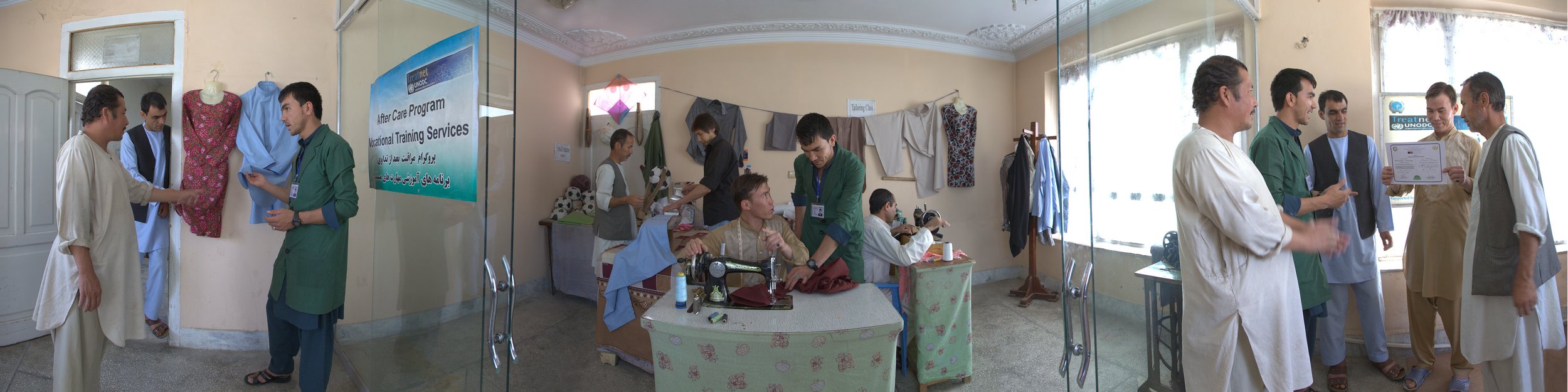
Rehabilitation extends well beyond the device itself. Occupational therapy helps veterans relearn daily tasks such as cooking, dressing, and using public transport. Vocational counselling identifies transferable skills and, where possible, matches veterans with employers willing to accommodate physical limitations. In Kabul, a partnership between the UN and a local vocational institute has trained several hundred disabled veterans in computer repair, tailoring, and small appliance maintenance, fields where dexterity and problem-solving matter more than mobility.
Psychological support is woven into these programs because many amputees also experience post-traumatic stress, depression, or anxiety. Group therapy sessions, often facilitated by former patients who have successfully returned to work, provide both peer support and practical role models. The UN's collaboration with the Afghan Ministry of Martyrs and Disabled Affairs has embedded psychologists in three regional rehabilitation centres, an arrangement that acknowledges mental health as inseparable from physical recovery.
Community reintegration is where many programs succeed or fail. A veteran who walks confidently through a bazaar, climbs into a shared taxi, or returns to his family's agricultural plot signals to neighbours that disability does not equal inability. Local imams, teachers, and tribal elders are sometimes invited to rehabilitation graduations to reinforce this message. The wider UN presence in Afghan cities supports this reintegration through livelihood and urban services programs; readers interested in how the organisation strengthens municipal systems can learn more about waste management in Mazar, which creates employment opportunities that disabled workers can fill.
Australian parallels in veteran rehabilitation
Australia's approach to veteran disability offers useful comparison points for any observer of the Afghan programs. The Department of Veterans' Affairs funds prosthetics, home modifications, and rehabilitation therapy for eligible former service personnel, while the National Disability Insurance Scheme covers a broader population, including veterans who do not meet DVA criteria. Together, these schemes ensure that Australian amputees, whether from recent deployments or decades-old injuries, can access advanced devices such as myoelectric arms and microprocessor knees.
Clinics in Melbourne, Sydney, and Brisbane are recognised internationally for their prosthetic research, and several Australian universities collaborate with manufacturers to trial new socket designs and liners. The country also hosts the Australian Invictus Games team, which highlights the athletic achievements of wounded veterans and has inspired rehabilitation programs in other nations. Watching an Australian veteran run, swim, or cycle on a prosthetic limb sends a powerful message that recovery is measured in capability, not limitation.
Australian veterans themselves sometimes participate in knowledge exchange programs in the Indo-Pacific region. While direct exchanges with Afghanistan have been complicated by security conditions, physiotherapists and prosthetists from Sydney's Royal North Shore Hospital have contributed to online training modules used in several conflict-affected countries. These partnerships reflect a broader Australian commitment to disability inclusion that extends beyond its own borders, anchored by legislation such as the Disability Discrimination Act and supported by national awareness campaigns.
Funding, logistics, and persistent challenges
Money shapes every aspect of these programs. The UN's annual appeals for Afghanistan have historically been underfunded, leaving rehabilitation centres to operate with reduced staff and shorter hours. When donor fatigue sets in, waiting lists grow and follow-up care is deferred, increasing the risk that newly fitted limbs go unused because patients cannot afford transport to adjustment appointments. Currency volatility inside Afghanistan further complicates procurement, since international funds must be converted at fluctuating rates.
Security is another constraint. Movement of rehabilitation teams in contested districts requires armed escorts or local ceasefires, both of which add cost and complexity. Female therapists in particular face restrictions on travel and dress that limit where they can work. Despite these pressures, several centres have maintained continuous operations for more than fifteen years, relying on local staff who understand the terrain and the politics.
There is also the challenge of measuring success. Counting devices delivered is straightforward, but counting lives transformed is harder. The UN has invested in outcome tracking systems that record employment status, pain levels, and mobility scores at six and twelve months post-fitting. Early results suggest that veterans who complete the full rehabilitation cycle are twice as likely to be economically active as those who receive only a device and no therapy. That kind of data helps justify continued investment and gives donors confidence that their contributions yield durable change.
Building local capacity for the long term
Sustainability is the recurring theme in every UN briefing on Afghan rehabilitation. Importing foreign experts indefinitely is neither affordable nor desirable, so the focus has shifted toward training local prosthetists, orthotists, and physiotherapists. Two-year diploma programs in Kabul, supported by the International Society for Prosthetics and Orthotics, have produced several hundred graduates who now staff centres across the country. Many of these graduates are themselves people with disabilities, bringing empathy and lived experience to their clinical work.
Curriculum development has also been a quiet success. UN agencies have worked with Kabul University and the Afghan Polytechnic Institute to align their allied health courses with international standards, allowing graduates to pursue further qualifications abroad if they choose. Several alumni have completed master's degrees in Australia, returning home with research skills that strengthen local evidence-based practice and contribute to global knowledge on affordable prosthetic design.
Community-based rehabilitation, where trained workers visit patients in their villages rather than waiting for referrals to urban clinics, has expanded steadily. This model, championed by WHO, reaches patients who would otherwise never travel and is particularly suited to a country where roads are poor and security unpredictable. The Australian context reminds us that geography is not destiny; distance from a major centre should not determine access to quality care.
Practical steps to strengthen support
Improvement in this field requires coordinated action across several fronts, from the clinic to the donor meeting room. The following measures would reinforce existing UN efforts and help Afghan veterans regain the independence they lost to conflict.
- Expand scholarship programs for Afghan prosthetists and physiotherapists to study in regional universities, including Australian institutions that offer relevant postgraduate courses.
- Increase multi-year funding commitments so that rehabilitation centres can retain trained staff and maintain a consistent supply of components.
- Integrate mental health services more deeply into physical rehabilitation, ensuring that veterans receive counselling alongside their device fittings.
- Support women-only therapy hours and train more female rehabilitation professionals to reach patients currently excluded by cultural barriers.
- Develop local manufacturing capacity for low-cost prosthetic components, reducing dependence on long-distance imports.
- Strengthen data collection on long-term outcomes, so that success is measured in employment and quality of life rather than devices delivered.
- Encourage workplace partnerships that hire disabled veterans, sending a visible signal that reintegration is both possible and economically beneficial.
Every veteran who walks back into a workplace, a classroom, or a family compound represents a quiet victory for dignity and resilience. The UN's sustained work on prosthetics and rehabilitation in Afghanistan demonstrates that even in the most difficult circumstances, mobility can be restored and lives can be rebuilt. For readers inspired by these stories, the next step is to learn more about the broader UN presence in Afghan communities, share this information with others who care about disability rights, and consider supporting the organisations and campaigns that keep these essential services running year after year.