
Making a Difference
Afghan Women's Legal Aid Clinics Bring UN-Backed Support to Domestic Violence Survivors
For women living in provinces where customary justice has long shaped family disputes, finding a qualified lawyer can feel as remote as reaching a city by foot. UN-funded legal aid clinics scattered across Afghanistan have worked to close that distance, offering free counsel to survivors of domestic violence who would otherwise navigate courts alone. The model has drawn quiet attention from policymakers abroad, including legal aid advocates in Australia who see parallels between remote service gaps in their own country and the rural outreach programmes running from Herat to Jalalabad.
The clinics sit at a crossroads of international development funding, Afghan civil society and grassroots women's networks. Their work intersects with broader UN messaging about gender equality, even as the political environment around women's rights in Afghanistan has shifted dramatically. Understanding how these clinics emerged, what they actually do, and what they have achieved offers a useful lens for Australian readers who follow overseas aid debates or who support the women affected through resettlement pathways.
Origins of a Modest but Persistent Model
The first women's legal aid clinics appeared under transitional justice initiatives in the early 2000s, when the United Nations Assistance Mission in Afghanistan worked alongside the Ministry of Justice to rebuild court capacity. UN agencies such as UN Women and the United Nations Development Programme partnered with Afghan non-governmental organisations to staff small offices run entirely by female lawyers, paralegals and counsellors. Their original remit focused on helping women understand divorce procedures, child custody rules and inheritance claims, areas of Sharia and statutory law where women had historically been excluded from negotiation.
Over time, the clinics absorbed a more specific mandate. Domestic violence, which Afghan law defines across a spectrum from verbal threats to physical assault, became the single most common reason women walked through their doors. Funding shifted accordingly, with multi-year grants covering interpreter fees, transport subsidies for clients travelling from neighbouring districts, and the production of plain-language information booklets in Dari and Pashto. The clinics also trained police liaison officers, hospital social workers and mullahs on referral pathways, building an informal network that stretched far beyond the capital.
What the Clinics Actually Provide
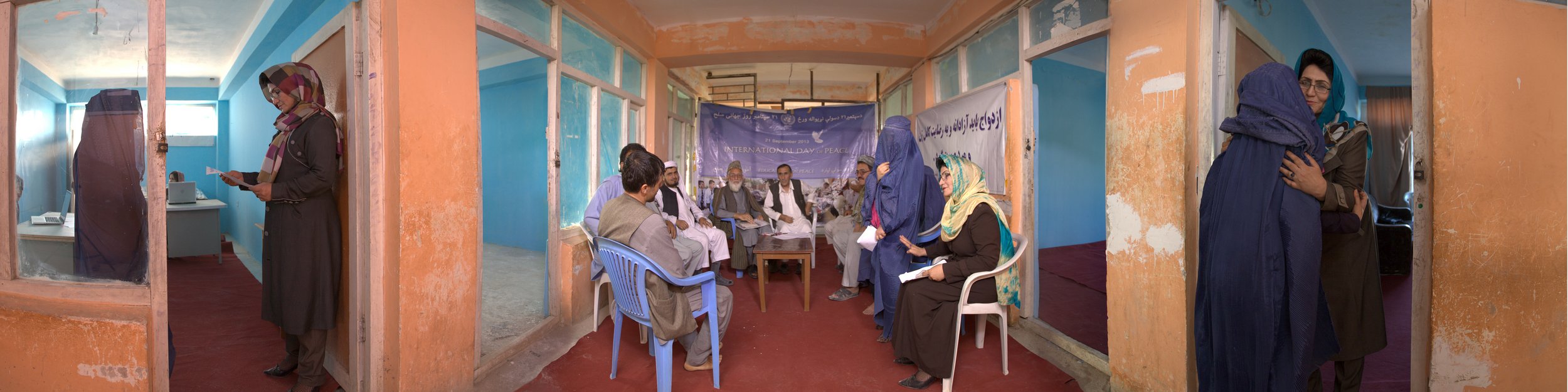
A woman arriving at a typical clinic is greeted by a female intake officer who records her story in a private room, separated from waiting male relatives. The intake process determines whether her case involves criminal assault, family breakdown, property dispute or a combination. Paralegals then translate the relevant sections of Afghan law, the Elimination of Violence Against Women law passed in 2009, the Penal Code and family regulations, into language a farmer's wife or a market trader can follow. Lawyers accompany clients to the Family Guidance Centre, to mediation sessions with village elders, or to provincial courts when formal prosecution is requested.
Where state services fall short, clinics step in. Many survivors need protection orders, a legal instrument available under Afghan law but rarely enforced without advocacy. Others seek divorce or child custody, both areas where courts have historically favoured male relatives. A smaller group of clients use clinic services to formalise marriages, register births or claim land, paperwork that protects them from future abuse. All services are offered at no cost, and clinics maintain a strict policy against sharing client information with family members or community figures without consent.
Barriers That Remain Despite Funding
Geography remains the single largest obstacle. Afghanistan's mountainous terrain means a woman in a remote district of Badakhshan may need two days of travel to reach the nearest clinic, often without a male mahram permitted by her family. Cost is the second barrier: even when legal services are free, the bus fare, a relative's accommodation in the city, and lost wages from days away from a small shop or farm put clinics out of reach for many survivors. Cultural pressure adds a third layer, with shame and family reputation discouraging reporting altogether.
The political environment has compounded these obstacles. Restrictions on women's movement, education and employment introduced since 2021 have affected clinic staffing, with some female lawyers relocating abroad and others working under strict operational limits. Reports from international monitors suggest that several clinics have continued operating in modified forms, often through home-based consultations or restricted hours, while a number have suspended in-person services entirely. International funding streams that supported the model have been re-evaluated against this backdrop, with some donors suspending grants and others channelling resources through diaspora-based partners.
Oversight, Training and Professional Standards
UN funding for the clinics has always been tied to specific compliance and reporting requirements. Implementing partners must submit quarterly case data, follow standardised intake protocols, and allow independent monitoring visits. Lawyers receive continuous training on evidence handling, trauma-informed interviewing and the proper documentation of injuries for court use. Many clinics also run legal literacy workshops in schools and women's centres, teaching girls about their rights before they reach adulthood.
Quality assurance has been a consistent feature even as donor priorities have shifted. The UN's work on gender-based violence in conflict settings follows guidance set out in the IASC Handbook on Gender-Based Violence Intervention, which outlines minimum standards for safe spaces, confidentiality and referral. Afghan clinics have generally met these benchmarks, although periodic reviews have flagged gaps in psychosocial support, particularly for survivors suffering long-term trauma. Training modules developed with Australian legal academics have occasionally been used, drawing on shared expertise between practitioners in both countries.
What Australian Audiences Can Take From the Story
Australian readers will recognise familiar patterns in the Afghan clinic experience. In rural New South Wales, survivors of family violence often travel hundreds of kilometres to access a specialist domestic violence court, and services such as Women's Legal Service NSW have long argued for expanded outreach. Indigenous communities in the Northern Territory face comparable distance barriers, and Aboriginal Legal Services operate mobile units that mirror the Afghan model in spirit. Melbourne-based researchers at RMIT and the University of Melbourne have studied how interpreter shortages affect legal outcomes in both Afghan and Pacific Islander communities, reinforcing the value of culturally tailored advice.
Australian legislation offers another point of comparison. The federal Family Law Act 1975 governs divorce, parenting and property matters, while each state and territory enforces its own intervention order regime. The National Plan to End Violence against Women and Children 2022-2032 commits governments to a shared framework that includes legal aid funding, recognising that access to justice is uneven across the country. The Afghan experience suggests that free, female-staffed clinics in regional centres, paired with strong referral networks, can shift outcomes for survivors, a finding that resonates with calls from Australian frontline services like 1800RESPECT and frontline women's centres in Perth and Brisbane for more localised legal support.
Outcomes, Data and the Road Ahead
Measuring impact in conflict-affected settings is difficult, but clinic operators have published encouraging figures. Between 2018 and 2021, the major UN-supported clinics collectively handled more than thirty thousand legal consultations, with protection orders granted in roughly sixty per cent of contested cases. Surveys of former clients consistently report increased awareness of legal rights and a greater willingness to seek help in future incidents. Donor reviews have nevertheless cautioned that quantitative success tells only part of the story, and qualitative indicators such as client confidence and community attitudes remain harder to capture.
The future of the clinics depends largely on political conditions and donor willingness to continue funding under restrictive operating rules. Some Australian-linked organisations, including diaspora groups in Sydney and Melbourne, have raised funds to keep at least some services running through remote channels. Others have called for a renewed UN compact that places women's access to justice at the centre of any future engagement strategy, whatever the broader diplomatic posture may be.
| Feature | Afghan UN-Funded Women's Legal Aid Clinics | Comparable Australian Legal Aid Services |
|---|---|---|
| Primary Clients | Women in rural and semi-urban districts, often survivors of domestic violence | Women across metropolitan, regional and remote areas of Australia |
| Staffing | Female lawyers, paralegals and counsellors; strict no-male-staff policy during consultations | Mix of male and female lawyers; female-only intake available on request through some services |
| Core Services | Protection orders, divorce, custody, inheritance, marriage and birth registration | Family law, intervention orders, child protection, family violence legal advice |
| Funding | UN agencies, bilateral donors, international NGOs | Federal and state legal aid commissions, Aboriginal Legal Services, community legal centres |
| Accessibility | Limited to provincial centres; travel subsidies for distant clients | Outreach offices, telephone advice lines, video conferencing, mobile services in remote regions |
| Cultural Adaptation | Services delivered in Dari and Pashto; awareness of tribal dispute resolution | Interpreters in over fifty languages; services designed with Aboriginal and Torres Strait Islander communities |
Practical Steps for Readers Who Want To Help
- Support Australian community legal centres that provide free family violence advice, including centres serving newly arrived Afghan women in cities such as Melbourne, Sydney and Brisbane.
- Volunteer with organisations that train bilingual community educators, an approach modelled on Afghan clinic outreach and now used in Australian settlement services.
- Donate to legal aid funds earmarked for regional and remote women, where service gaps mirror the Afghan rural access problem.
- Encourage local councils in Australia to fund female-staffed outreach teams, a model that has proved effective both in Afghan provinces and in Western Australian regional pilots.
- Advocate for sustained UN funding of women's legal aid in Afghanistan, including through diaspora networks that already operate in Australia.
- Share plain-language legal information in community languages, following the Afghan clinic practice of distributing rights booklets in Dari and Pashto.
- Back research partnerships between Australian universities and Afghan legal aid providers, an area where academic exchange has already produced useful training resources.
The Afghan clinics represent something durable even amid uncertainty. They show that well-designed, properly funded legal services can give women options they would otherwise lack, and that small acts of legal accompaniment can reshape a survivor's trajectory. Australian readers who care about gender equality overseas and at home can act on that lesson today, whether by volunteering with a local legal aid centre, supporting resettlement organisations in their city, or pressing policymakers to keep women's access to justice on the diplomatic agenda. The women waiting in clinic foyers from Balkh to Badghis deserve the same commitment that Australia already shows its own survivors, and the chance to see that commitment continue.